
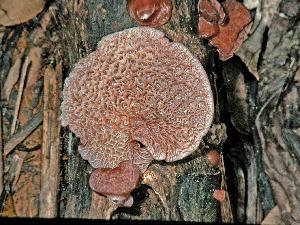
Auricularia subglabra (originally reported as A. delicata)
This genome was sequenced as a part of the large-scale multi-genome JGI CSP Saprotrophic Agaricomycotina Project (SAP), which focuses on the diversity and evolution of decay mechanisms, organismal phylogenetic relationships, and developmental evolution. A large collaborative effort led by PI of this project, David Hibbett (Clark University) aims for master publication(s) of the SAP data analysis. Researchers who wish to publish analyses using data from unpublished SAP genomes are respectfully required to contact the PI and JGI to avoid potential conflicts on data use and coordinate other publications with the SAP master paper(s). This genome has been published.
Auricularia subglabra is known only from montane cloud forests of Costa Rica (this genome was originally deposited under the name Auricularia delicata, which is a similar species, originally described from Africa, that may have a pantropical distribution). The genus Auricularia belongs to a morphological group called the "jelly-fungi" based on the gelatinous consistency of the fruiting bodies. Jelly-fungi have evolved independently in three classes of Agaricomycotina: Tremellomycetes, Dacrymycetes, and Agaricomycetes; the latter is roughly equivalent to the mushroom-forming fungi. Auricularia includes many edible species, such as the highly priced wood ear or Mu-Err fungus (A. auricula-judae) that play important roles in global economies. Reported medicinal properties including antilipemic and antiageing effects and immunological function increase in mice are attributed to some species, however, the beneficial compounds responsible have not been characterized in A. subglabra. Auricularia species produce a white rot on dead and decaying wood. Auricularia produces class II heme peroxidases (e.g., lignin peroxidases LiP and manganese peroxidases MnP) found in other groups of white rot fungi. In addition, dye-decolorizing peroxidases (DyP) with manganese-independent peroxidase activities have been demonstrated. Further studies are needed to assess the ligninolytic potential of DyP enzymes in the biodegradation and conversion of synthetic dyes that are harmful to the environment. The genome sequence of A. subglabra provides clues to the diversity of enzymes involved in white rot early in the evolution of Agaricomycetes.
Publication:
Floudas D, Binder M, Riley R, Barry K, Blanchette RA, Henrissat B, Martínez AT, Ortillar R, Spatafora JW, Yadav JS, Aerts A, Benoit I, Boyd A, Carlson A, Copeland A, Coutinho PM, de Vries RP, Ferreira P, Findley K, Foster B, Gaskell J, Glotzer D, Górecki P, Heitman J, Hesse C, Hori C, Igarashi K, Jurgens JA, Kallen N, Kersten P, Khajamohiddin A, Kohler A, Kues U, Kumar TKA, Kuo A, LaButti K, Larrondo LF, Lindquist E, Ling A, Lucas S, Lundell T, Martin R, McLaughlin DJ, Morgenstern I, Morin E, Murat C, Nolan M, Ohm RA, Patyshakuliyeva A, Rokas A, Ruiz-Dueñas FJ, Sabat G, Salamov A, Samejima M, Schmutz J, Slot JC, John FS, Stenlid J, Sun H, Sun S, Tsang A, Wiebenga A, Young D, Pisabarro A, Eastwood DC, Martin F, Cullen D, Grigoriev IV, Hibbett DS (2012)The Paleozoic origin of enzymatic lignin decomposition reconstructed from 31 fungal genomes. Science. 336(6089):1715-1719.
Additional reference:
Looney, B. P., J. M. Birkebak and P. B. Matheny. 2013. Systematics of the genus Auricularia with an emphasis on species from the southeastern United States. North American Fungi 8:1-25.
