
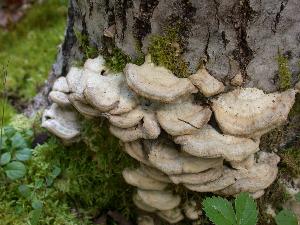
This genome was sequenced as a part of the large-scale multi-genome JGI CSP Saprotrophic Agaricomycotina Project (SAP), which focuses on the diversity and evolution of decay mechanisms, organismal phylogenetic relationships, and developmental evolution. A large collaborative effort led by PI of this project, David Hibbett (Clark University) aims for master publication(s) of the SAP data analysis. Researchers who wish to publish analyses using data from unpublished SAP genomes are respectfully required to contact the PI and JGI to avoid potential conflicts on data use and coordinate other publications with the SAP master paper(s).
Bjerkandera adusta is a widely distributed wood decay fungus commonly associated with the decomposition of hardwoods. Microscopic thread-like hyphae colonize and degrade dead wood, and visually striking shelf-like fruiting bodies often appear on the surface. During the decay process, all components of the wood cell walls are degraded including the cellulose, hemicellulose and recalcitrant lignin. Accordingly, this species is often referred to as a 'white-rot' fungus and related to other sequenced fungi such as Phanerochaete chrysosporium, Cerioporiopsis subvermispora, and Trametes versicolor. Comparative analyses of these species reveal variations in the mechanism(s) by which lignocellulose is degraded, although it is generally thought that extracellular oxidative mechanisms play a crucial role in lignin depolymerization. The remarkable oxidation potential of the secreted peroxidases has attracted considerable attention and, in addition to plant cell wall deconstruction, B. adusta has shown considerable promise in the degradation of a wide range of environmental pollutants.
Genome Reference(s)
Binder M, Justo A, Riley R, Salamov A, Lopez-Giraldez F, Sjökvist E, Copeland A, Foster B, Sun H, Larsson E, Larsson KH, Townsend J, Grigoriev IV, Hibbett DS
Phylogenetic and phylogenomic overview of the Polyporales.
Mycologia. 2013 Nov-Dec;105(6):1350-73. doi: 10.3852/13-003
