
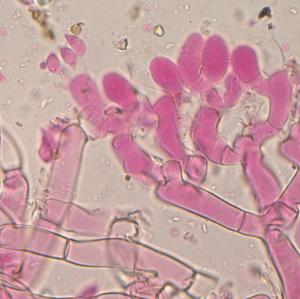
This genome was sequenced as a part of the large-scale multi-genome JGI CSP Saprotrophic Agaricomycotina Project (SAP), which focuses on the diversity and evolution of decay mechanisms, organismal phylogenetic relationships, and developmental evolution. A large collaborative effort led by PI of this project, David Hibbett (Clark University) aims for master publication(s) of the SAP data analysis. Researchers who wish to publish analyses using data from unpublished SAP genomes are respectfully required to contact the PI and JGI to avoid potential conflicts on data use and coordinate other publications with the SAP master paper(s).
Botryobasidium botryosum (Bres.) J. Erikss. is a basidiomycete species that produces thin, resupinate, grayish to yellowish basidiocarps on wood debris and characteristic navicular basidiospores (Langer, 1994). The species is widespread in different habitats in the northern hemisphere and the basidiocarps are associated with diverse kinds of wood. The ecology and nutritional strategy of the species, as well as other Botryobasidium spp., are not well known. Few species have been repeatedly collected on brown-rotted wood (e.g. B. ponderosum, Larsen et al., 1996), but it is not clear if the species of the genus are responsible for this type of degradation. Recently ITS sequences were generated from roots of the orchid genus Apostasia, belonging to a Botryobasidium sp., suggesting a mycorrhizal association of some species of the genus with this orchid genus (Yukawa et al., 2009). Botryobasidium has been resolved as a monophyletic genus and the genus forms the sister clade of the rest of Cantharellales (Moncalvo et al., 2006), which comprise of ecologically very interesting genera such as Cantharellus, Craterellus, Ceratobasidium and Thanatephorus including mycorrhizal and parasitic species. The genome sequence of B. botryosum will increase our understanding about the nutritional status of the species especially regarding the relationship of the species to wood degradation and will provide new opportunities for studies on nutritional transitions in Cantharellales.
Genome Reference(s)
Riley R, Salamov AA, Brown DW, Nagy LG, Floudas D, Held BW, Levasseur A, Lombard V, Morin E, Otillar R, Lindquist EA, Sun H, LaButti KM, Schmutz J, Jabbour D, Luo H, Baker SE, Pisabarro AG, Walton JD, Blanchette RA, Henrissat B, Martin F, Cullen D, Hibbett DS, Grigoriev IV
Extensive sampling of basidiomycete genomes demonstrates inadequacy of the white-rot/brown-rot paradigm for wood decay fungi.
Proc Natl Acad Sci U S A. 2014 Jul 8;111(27):9923-8. doi: 10.1073/pnas.1400592111
