
This genome was sequenced as a part of the large-scale multi-genome JGI CSP Saprotrophic Agaricomycotina Project (SAP), which focuses on the diversity and evolution of decay mechanisms, organismal phylogenetic relationships, and developmental evolution. A large collaborative effort led by PI of this project, David Hibbett (Clark University) aims for master publication(s) of the SAP data analysis. Researchers who wish to publish analyses using data from unpublished SAP genomes are respectfully required to contact the PI and JGI to avoid potential conflicts on data use and coordinate other publications with the SAP master paper(s).
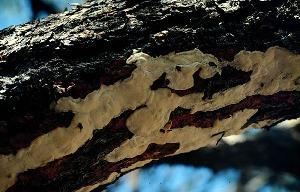
Dichomitus squalens (P. Karst.) D.A. Reid is a wood rotting Basidiomycete, which produces basidiocarps with poroid hymenophore. The common name of the species, western red rot, indicates the ability of the species to cause a white pocket rot, with the initial decay stage giving a red coloration to the wood followed by the full discoloration of the wood tissue with extensive damage of the structure due to lignin degradation. The species is collected mainly on conifer trees and usually causes major damages to the economically important conifer Pinus ponderosa (Ponderosa Pine). Various types of enzymatic activities related with the ligninocellulolytic system have been shown in liquid cultures of Dichomitus squalens such as endoglucanases, cellobiohydrolases, xylanases, galacturonases and cellobiose dehydrogenases. It has also been shown to produce laccases and manganese peroxidases on both liquid and solid cultures with wheat straw and pine wood chips. Furthermore the species can effectively degrade synthetic dyes in liquid media such as azo and triphenylmethane dyes. The white rot biochemistry makes the species a good candidate for studies on lignin and cellulose degradation. The genome sequencing of Dichomitus squalens will provide more information on the ligninocellulolytic potential of the Basidiomycetes and will give us the tools for extensive studies in this field. Additionally, the genome of this species will give us the opportunity to obtain more information on how the species so efficiently attack the economically important Ponderosa Pine. What is more, the synthetic dye degradation ability of the species is a promising factor for applications on bioremediation studies. Finally, it will reinforce comparative studies with other species of the Polyporales for which the genome is currently available or will be sequenced in the future such as Postia placenta and Trametes versicolor.
Genome Reference(s)
Floudas D, Binder M, Riley R, Barry K, Blanchette RA, Henrissat B, Martínez AT, Otillar R, Spatafora JW, Yadav JS, Aerts A, Benoit I, Boyd A, Carlson A, Copeland A, Coutinho PM, de Vries RP, Ferreira P, Findley K, Foster B, Gaskell J, Glotzer D, Górecki P, Heitman J, Hesse C, Hori C, Igarashi K, Jurgens JA, Kallen N, Kersten P, Kohler A, Kües U, Kumar TK, Kuo A, LaButti K, Larrondo LF, Lindquist E, Ling A, Lombard V, Lucas S, Lundell T, Martin R, McLaughlin DJ, Morgenstern I, Morin E, Murat C, Nagy LG, Nolan M, Ohm RA, Patyshakuliyeva A, Rokas A, Ruiz-Dueñas FJ, Sabat G, Salamov A, Samejima M, Schmutz J, Slot JC, St John F, Stenlid J, Sun H, Sun S, Syed K, Tsang A, Wiebenga A, Young D, Pisabarro A, Eastwood DC, Martin F, Cullen D, Grigoriev IV, Hibbett DS
The Paleozoic origin of enzymatic lignin decomposition reconstructed from 31 fungal genomes.
Science. 2012 Jun 29;336(6089):1715-9. doi: 10.1126/science.1221748
