
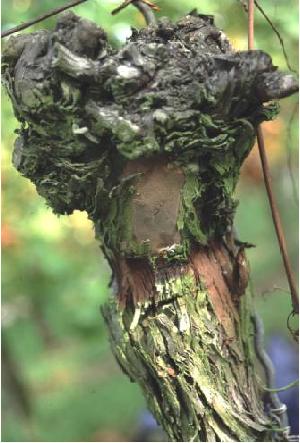
This genome was sequenced as a part of the large-scale multi-genome JGI CSP Saprotrophic Agaricomycotina Project (SAP), which focuses on the diversity and evolution of decay mechanisms, organismal phylogenetic relationships, and developmental evolution. A large collaborative effort led by PI of this project, David Hibbett (Clark University) aims for master publication(s) of the SAP data analysis. Researchers who wish to publish analyses using data from unpublished SAP genomes are respectfully required to contact the PI and JGI to avoid potential conflicts on data use and coordinate other publications with the SAP master paper(s).
Fomitiporia mediterranea is a wood-decaying basidiomycete that produces inconspicuous resupinate polypore fruiting bodies and that is a pathogen of Vitis vinifera, the wine grape (Amalfi et al. 2010; Fischer, 2002). The fungus produces an extensive white rot in the trunks of growing Vitis plants, which is one symptom of the destructive grapevine disease complex esca, which may involve a consortium of pathogens. In addition to being significant as a white rot fungus and plant pathogen, F. mediterranea is the first representative of the order Hymenochaetales to have its genome sequenced. The Hymenochaetales includes diverse wood decay fungi that produce an aggressive white rot and that are often dominant components of wood decay communities (e.g., Hymenochaete, Hydnochaete, Phellinus, Trichaptum), including pathogens that attack live woody plants, and saprotrophs that inhabit dead wood. Prior studies using polymerase chain reaction amplification of class II fungal peroxidases indicated that F. mediterranea possesses manganese peroxidases that are similar to those of the distantly related model white rot organism Phanerochaete chrysosporium, which is in the Polyporales (Morgenstern et al. 2010). The F. mediterranea genome will provide a first look at the complete decay apparatus of an important clade of wood-degrading basidiomycetes that may have unique features of potential applied utility that are not found in the currently best known model systems for decay biology and biochemistry.
Genome Reference(s)
Floudas D, Binder M, Riley R, Barry K, Blanchette RA, Henrissat B, Martínez AT, Otillar R, Spatafora JW, Yadav JS, Aerts A, Benoit I, Boyd A, Carlson A, Copeland A, Coutinho PM, de Vries RP, Ferreira P, Findley K, Foster B, Gaskell J, Glotzer D, Górecki P, Heitman J, Hesse C, Hori C, Igarashi K, Jurgens JA, Kallen N, Kersten P, Kohler A, Kües U, Kumar TK, Kuo A, LaButti K, Larrondo LF, Lindquist E, Ling A, Lombard V, Lucas S, Lundell T, Martin R, McLaughlin DJ, Morgenstern I, Morin E, Murat C, Nagy LG, Nolan M, Ohm RA, Patyshakuliyeva A, Rokas A, Ruiz-Dueñas FJ, Sabat G, Salamov A, Samejima M, Schmutz J, Slot JC, St John F, Stenlid J, Sun H, Sun S, Syed K, Tsang A, Wiebenga A, Young D, Pisabarro A, Eastwood DC, Martin F, Cullen D, Grigoriev IV, Hibbett DS
The Paleozoic origin of enzymatic lignin decomposition reconstructed from 31 fungal genomes.
Science. 2012 Jun 29;336(6089):1715-9. doi: 10.1126/science.1221748
References
Amalfi, M., P. Yombiyeni, and C. Decock. 2010. Fomitiporia in sub-Saharan Africa: morphology and multigene phylogenetic analysis support three new species from the Guineo-Congolian rainforest. Mycologia 102: 1303-1317. doi: 10.3852/09-083
Fischer, M. 2002. A new wood-decaying basidiomycete species associated with esca of grapevine: Fomitiporia mediterranea (Hymenochaetales). Mycological Progress 1: 315-324
Morgenstern, I., D. Robertson, and D. Hibbett. 2010. Characterization of 3 mnp genes in Fomitiporia mediterranea and report of additional class II peroxidases in the Hymenochaetales. Applied and Environmental Microbiology 76: 6431–6440 doi:10.1128/AEM.00547-10.
