
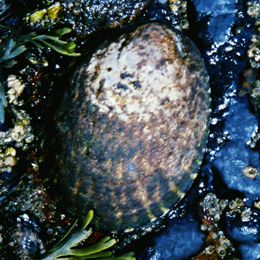
Molluscs are among the most diverse animal phyla, found throughout marine, freshwater, and terrestrial habitats, and include important aquaculture species, environmental sentinels, destructive pests, and disease vectors. Most exhibit spiral cleavage and a trochophore larva, two ancient developmental features shared with a number of other lophotrochozoan protostome phyla, including annelids, and conserved since at least the early Cambrian, over 540 million years ago. Lophotrochozoans are one of three major bilaterian clades but lack a genome-enabled representative.
The gastropod snail Lottia gigantea was chosen as the first lophotrochozoan for whole genome sequencing because the species is an emerging model in evolution and development, ecology, and conservation. The genus is relatively recent in origin and highly diverse, with over 150 species in the Pacific Basin, where they are often conspicuous and important members of the intertidal fauna. Their genome is small relative to other molluscs, consisting of about 500 mega base pairs.
The complete L. gigantea genome sequence will provide a foundation for elucidating the evolutionary and ecological success of the species and its lineage and will provide a critical point of comparison for understanding the early diversification of animals and their genomes.
Genome Reference(s)
Simakov O, Marletaz F, Cho SJ, Edsinger-Gonzales E, Havlak P, Hellsten U, Kuo DH, Larsson T, Lv J, Arendt D, Savage R, Osoegawa K, de Jong P, Grimwood J, Chapman JA, Shapiro H, Aerts A, Otillar RP, Terry AY, Boore JL, Grigoriev IV, Lindberg DR, Seaver EC, Weisblat DA, Putnam NH, Rokhsar DS
Insights into bilaterian evolution from three spiralian genomes.
Nature. 2013 Jan 24;493(7433):526-31. doi: 10.1038/nature11696
