
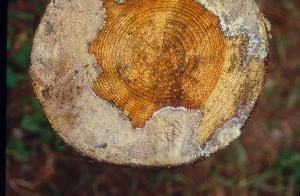
This genome was sequenced as a part of the large-scale multi-genome JGI CSP Saprotrophic Agaricomycotina Project (SAP), which focuses on the diversity and evolution of decay mechanisms, organismal phylogenetic relationships, and developmental evolution. A large collaborative effort led by PI of this project, David Hibbett (Clark University) aims for master publication(s) of the SAP data analysis. Researchers who wish to publish analyses using data from unpublished SAP genomes are respectfully required to contact the PI and JGI to avoid potential conflicts on data use and coordinate other publications with the SAP master paper(s).
Phlebiopsis gigantea is a basidiomycete belonging to a small group of microbes that are uniquely able to efficiently depolymerize, degrade, and mineralize lignin. Collectively referred to as white rot fungi, most are saprophytes that readily colonize hardwood substrates. Well-known examples previously sequenced by the Joint Genome Institute include Phanerochaete chrysosporium and Ceriporiopsis subvermispora. Although closely related to these species, the white rot fungus P. gigantea is distinct in its ability to rapidly colonize the freshly cut sapwood of conifers. The mechanisms by which this fungus degrades cell walls and the resinous components in conifer wood are poorly understood. This unusual capability has led to the development of P. gigantea as a biocontrol agent against subsequent colonization by the root rot pathogen Heterobasidium annosum and by blue stain fungi. Little is known about the mechanism(s) by which white rot fungi degrade conifer extractives, but it is expected that comparative genome analyses of P. gigantea and closely related Polyporales such as P. chrysosporium, C. subvermispora and P. carnosa will advance our understanding of the complex hydrolytic and oxidative mechanisms involved in plant cell wall deconstruction, especially of conifer wood. Ultimately, these results may provide new strategies and enzymes that enable the efficient conversion of coniferous feedstocks to high value, small molecular weight products for the further development of bioenergy/biofuels processes.
Genome Reference(s)
Hori C, Ishida T, Igarashi K, Samejima M, Suzuki H, Master E, Ferreira P, Ruiz-Dueñas FJ, Held B, Canessa P, Larrondo LF, Schmoll M, Druzhinina IS, Kubicek CP, Gaskell JA, Kersten P, St John F, Glasner J, Sabat G, Splinter BonDurant S, Syed K, Yadav J, Mgbeahuruike AC, Kovalchuk A, Asiegbu FO, Lackner G, Hoffmeister D, Rencoret J, Gutiérrez A, Sun H, Lindquist E, Barry K, Riley R, Grigoriev IV, Henrissat B, Kües U, Berka RM, Martínez AT, Covert SF, Blanchette RA, Cullen D
Analysis of the Phlebiopsis gigantea genome, transcriptome and secretome provides insight into its pioneer colonization strategies of wood.
PLoS Genet. 2014 Dec;10(12):e1004759. doi: 10.1371/journal.pgen.1004759
