
Mycosphaerella graminicola (anamorph: Septoria tritici ) is the cause of septoria tritici blotch, which in most years is the second most important disease of wheat in the United States, after rust, occurring in most wheat-growing areas every year. The disease occurs throughout the world, wherever wheat is grown. Yield losses caused by septoria tritici blotch can range from 30 to 50% but probably are more on the order of several percent annually in the United States. The economic damage caused by this disease probably is more than $275 million every year in lost revenue to U.S. wheat growers. This disease also is an important fungicide target in Europe, which is the most important market for cereal fungicides for the agrochemical industry, including a range of US companies. The estimated volume of fungicide input in this area is ~$400 million, which is approximately 70% of the total fungicide input in cereals. Losses in the developing world are difficult to estimate but M. graminicola infection is very severe in Mediterranean and East African countries, such as the highlands in Ethiopia, and likely significantly reduces yields of the world's most widely planted food crop.
Mycosphaerella graminicola is a haploid, hemibiotrophic ascomycete with both filamentous and yeast-like growth phases (yeast-like growth at 15 ° C and mycelial growth at 25 ° C). The fungus is easy to culture on both liquid and solid media. It has a bipolar, heterothallic mating system and crosses can be made easily on wheat leaves. Sexual recombination occurs frequently - several times per annum - in nature, and the population genetics of M. graminicola is better understood than that of any other fungus. Lab culture collections contain more than 5,000 field isolates and several invaluable mapping populations, which are available to the worldwide community. Other laboratory strains are available, including knock-out strains and experimental evolution populations that are expressing high levels of resistance to two classes of fungicides through accumulation of mutations during asexual reproduction. These strains will allow an analysis of the number of mutations involved in fungicide resistance. This is a first for a plant pathogen (as well as for a filamentous fungus) and puts M. graminicola in the same league as Candida albicans and S. cerevisiae as a model system for in vitro experimental evolution studies in fungi.
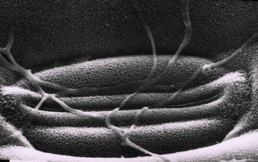
Phylogenetically, M. graminicola is distantly related to the other fungi proposed for sequencing. Thus, its genome would greatly expand the range for comparative analysis. The genus Mycosphaerella is in the order Dothideales, which contains no other good model species. In contrast to other model fungi, penetration of the host by M. graminicola occurs directly through the stomata without a melanized appressorium. Growth is symptomless and intercellular for 8-10 days before rapid collapse of mesophyll tissue occurs in compatible interactions. The rapid tissue collapse suggests an active role of toxic compounds, which are produced in vitro and could act as virulence factors. Lack of symptoms during early pathogenesis suggests that, if toxins are involved in the pathogenicity of M. graminicola , their production may be initiated by morphological or developmental triggers. Possible developmental regulation of toxin production late in the infection process may be an unusual characteristic of the wheat-M. graminicola interaction that cannot be analyzed in other model systems.
Genome Reference(s)
Goodwin SB, M'barek SB, Dhillon B, Wittenberg AH, Crane CF, Hane JK, Foster AJ, Van der Lee TA, Grimwood J, Aerts A, Antoniw J, Bailey A, Bluhm B, Bowler J, Bristow J, van der Burgt A, Canto-Canché B, Churchill AC, Conde-Ferràez L, Cools HJ, Coutinho PM, Csukai M, Dehal P, De Wit P, Donzelli B, van de Geest HC, van Ham RC, Hammond-Kosack KE, Henrissat B, Kilian A, Kobayashi AK, Koopmann E, Kourmpetis Y, Kuzniar A, Lindquist E, Lombard V, Maliepaard C, Martins N, Mehrabi R, Nap JP, Ponomarenko A, Rudd JJ, Salamov A, Schmutz J, Schouten HJ, Shapiro H, Stergiopoulos I, Torriani SF, Tu H, de Vries RP, Waalwijk C, Ware SB, Wiebenga A, Zwiers LH, Oliver RP, Grigoriev IV, Kema GH
Finished genome of the fungal wheat pathogen Mycosphaerella graminicola reveals dispensome structure, chromosome plasticity, and stealth pathogenesis.
PLoS Genet. 2011 Jun;7(6):e1002070. doi: 10.1371/journal.pgen.1002070
