
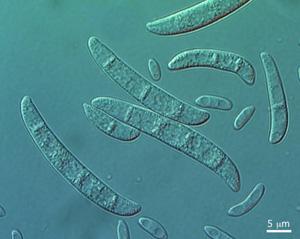
The fungus Fusarium vanettenii (formerly referred to as Nectria haematococca Mating Population VI (MPVI) and Fusarium solani f. sp. pisi) is a member of an evolutionary group called the Fusarium solani species complex (FSSC). F. vanettenii can be found in a broad range of environments and is capable of causing disease on a number of crops including pea, chickpea, tomato, carrots, potato, and alfalfa.
F. vanettenii is one of the most studied members of the FSSC and the genome of strain 77-13-4 was the first to be sequenced of any FSSC isolate (Coleman et al., 2009). Importantly, some of the genes controlling the ability of F. vanettenii to colonize specific habitats are located on conditionally dispensable supernumerary chromosomes ("CD chromosomes"), which were first described in this fungus in 1991. These chromosomes are known to carry habitat-defining genes involved in resistance to plant antibiotics, utilization of specific carbon and nitrogen sources, and host-specific pathogenicity. The most relevant aspect of the biology of the CD chromosomes is the evidence suggesting that they originated by horizontal gene transfer. The genomic sequence should assist with the identification of genes from specific biosynthetic and catabolic processes involved in the responses of this fungus to a variety of environmental conditions (e.g. toxic chemicals, stress, recalcitrant carbon sources, pathogenic vs. saprophytic growth, anaerobic growth, etc.). Thus, the genomic sequences of these fungi should be of great interest to a number of user communities, including those engaged in bioremediation, biotechnology, agriculture, evolutionary studies, comparative genomics, and computational biology.
Genome Reference(s)
Coleman JJ, Rounsley SD, Rodriguez-Carres M, Kuo A, Wasmann CC, Grimwood J, Schmutz J, Taga M, White GJ, Zhou S, Schwartz DC, Freitag M, Ma LJ, Danchin EG, Henrissat B, Coutinho PM, Nelson DR, Straney D, Napoli CA, Barker BM, Gribskov M, Rep M, Kroken S, Molnár I, Rensing C, Kennell JC, Zamora J, Farman ML, Selker EU, Salamov A, Shapiro H, Pangilinan J, Lindquist E, Lamers C, Grigoriev IV, Geiser DM, Covert SF, Temporini E, Vanetten HD
The genome of Nectria haematococca: contribution of supernumerary chromosomes to gene expansion.
PLoS Genet. 2009 Aug;5(8):e1000618. doi: 10.1371/journal.pgen.1000618
