
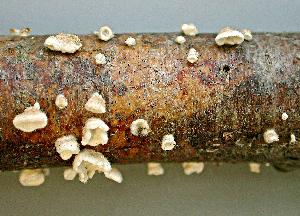
This genome was sequenced as a part of the large-scale multi-genome JGI CSP Saprotrophic Agaricomycotina Project (SAP), which focuses on the diversity and evolution of decay mechanisms, organismal phylogenetic relationships, and developmental evolution. A large collaborative effort led by PI of this project, David Hibbett (Clark University) aims for master publication(s) of the SAP data analysis. Researchers who wish to publish analyses using data from unpublished SAP genomes are respectfully required to contact the PI and JGI to avoid potential conflicts on data use and coordinate other publications with the SAP master paper(s).
Plicaturopsis crispa produces clusters of small, fan-shaped fruiting bodies with wrinkled spore bearing layers that resemble vein-like folds. There is a general notion that this fungus has been expanding its original southern range over the last few decades with temperatures increasing globally. Plicaturopsis crispa is an effective decayer in the initial phase of decay colonizing predominantly dead branches of deciduous trees (Fagus and Betula) and is associated with a white rot. After a couple of years into the succession of wood degradation, strong competitors such as Trametes versicolor and the split-gill fungus Schizophyllum commune displace P. crispa cumulatively. The Amylocorticiales, the group containing P. crispa, is a recently described order of Agaricomycetes including mostly resupinate fungi with saprotrophic and sometimes biotrophic lifestyles. In addition, the Amylocorticiales including roughly 70 species is sister to the Agaricales (13,000 species). The genome of P. crispa will be the first to represent the Amylocorticiales. The characterization of the Plicaturopsis genome will be crucial for comparative studies concerning the evolution of decay strategies in both the Amylocorticiales and Agaricales, adding to the larger picture of identifying the essential enzymatic mechanisms that are needed to function successfully as a white-rot fungus.
Genome Reference(s)
Kohler A, Kuo A, Nagy LG, Morin E, Barry KW, Buscot F, Canbäck B, Choi C, Cichocki N, Clum A, Colpaert J, Copeland A, Costa MD, Doré J, Floudas D, Gay G, Girlanda M, Henrissat B, Herrmann S, Hess J, Högberg N, Johansson T, Khouja HR, LaButti K, Lahrmann U, Levasseur A, Lindquist EA, Lipzen A, Marmeisse R, Martino E, Murat C, Ngan CY, Nehls U, Plett JM, Pringle A, Ohm RA, Perotto S, Peter M, Riley R, Rineau F, Ruytinx J, Salamov A, Shah F, Sun H, Tarkka M, Tritt A, Veneault-Fourrey C, Zuccaro A, Tunlid A, Grigoriev IV, Hibbett DS, Martin F
Convergent losses of decay mechanisms and rapid turnover of symbiosis genes in mycorrhizal mutualists.
Nat Genet. 2015 Apr;47(4):410-5. doi: 10.1038/ng.3223
