
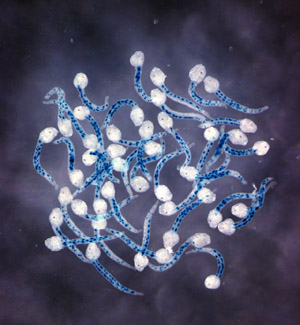
The Ciona intestinalis genome is the smallest of any experimentally manipulable chordate. This organism provides a good system for exploring the evolutionary origins of the chordate lineage, from which all vertebrates sprouted.
C. intestinalis has a good genomic infrastructure (EST and cDNA collections, BAC and cosmid libraries, etc.), easily visualized cells and morphogenetic processes, existing methods for transient transgene expressions, and is available throughout the world all year long. In addition, there is a deep classical literature on ascidian development, and an active community of researchers worldwide.
The complete C. intestinalis genome sequence will provide a foundation for genome-scale analysis of regulatory networks through development.
