
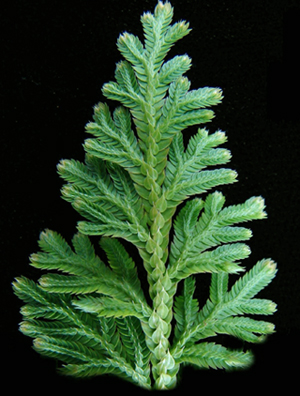
Spikemosses are among the few surviving members of the lycophytes, an ancient group of plants whose origins can be traced back as far as 400 million years ago. The lycophytes dominated the earth’s landscape during the Carboniferous Period (354-290 million years ago) and their remains can be seen and used today in the form of coal. Only three families of lycophytes survive today, including the Selaginellaceae (the spikemosses).
Phylogenetically, the lycophytes sit between the bryophytes and the euphyllophytes, which include the ferns, gymnosperms and flowering plants. As such, lycophytes are key to understanding how major innovations evolved in order for plants to survive and thrive on land. These innovations include vascular tissue, leaves, stems, and lignification, traits that are important both in agriculture and biofuel production.
The spikemoss Selaginella moellendorffii has a genome size of only ~100Mbp, which is the smallest genome size of any plant reported. The sequence of the Selaginella genome by JGI provides scientists an important reference genome necessary for deciphering the evolution of biochemical, physiological and developmental processes unique to land plants.
Genome Reference(s)
Banks JA, Nishiyama T, Hasebe M, Bowman JL, Gribskov M, dePamphilis C, Albert VA, Aono N, Aoyama T, Ambrose BA, Ashton NW, Axtell MJ, Barker E, Barker MS, Bennetzen JL, Bonawitz ND, Chapple C, Cheng C, Correa LG, Dacre M, DeBarry J, Dreyer I, Elias M, Engstrom EM, Estelle M, Feng L, Finet C, Floyd SK, Frommer WB, Fujita T, Gramzow L, Gutensohn M, Harholt J, Hattori M, Heyl A, Hirai T, Hiwatashi Y, Ishikawa M, Iwata M, Karol KG, Koehler B, Kolukisaoglu U, Kubo M, Kurata T, Lalonde S, Li K, Li Y, Litt A, Lyons E, Manning G, Maruyama T, Michael TP, Mikami K, Miyazaki S, Morinaga S, Murata T, Mueller-Roeber B, Nelson DR, Obara M, Oguri Y, Olmstead RG, Onodera N, Petersen BL, Pils B, Prigge M, Rensing SA, Riaño-Pachón DM, Roberts AW, Sato Y, Scheller HV, Schulz B, Schulz C, Shakirov EV, Shibagaki N, Shinohara N, Shippen DE, Sørensen I, Sotooka R, Sugimoto N, Sugita M, Sumikawa N, Tanurdzic M, Theissen G, Ulvskov P, Wakazuki S, Weng JK, Willats WW, Wipf D, Wolf PG, Yang L, Zimmer AD, Zhu Q, Mitros T, Hellsten U, Loqué D, Otillar R, Salamov A, Schmutz J, Shapiro H, Lindquist E, Lucas S, Rokhsar D, Grigoriev IV
The Selaginella genome identifies genetic changes associated with the evolution of vascular plants.
Science. 2011 May 20;332(6032):960-3. doi: 10.1126/science.1203810
